Showing posts with label black. Show all posts

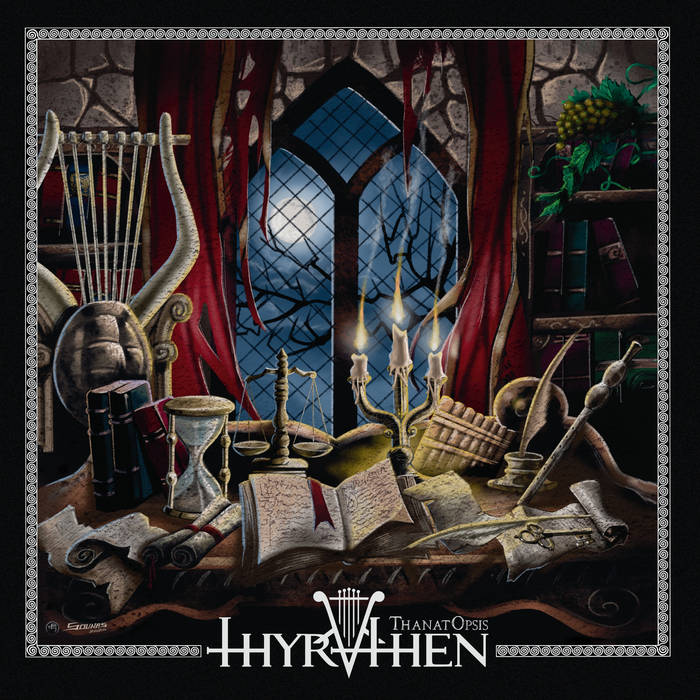
Thyrathen - Thanatopsis

It is always of interest to me when metal and contemplation are united. I chose the word contemplation, since the inspiration for the creation of an album can take many forms. A work of art can inspire art, but so can philosophy, history, religion, politics etc. The process of contemplation from the musicians is what brings the union of metal with something that also has an extensive body of ideas and forms.

In the case of Thanatopsis we begin with the union of ancient Greek tragedy on the Dionysian worship through the story of Euripides’s Bacchae with Hellenic black metal. Thyrathen structured the album like a tragedy and this is not just an ambitious task; it is a difficult task, or rather, a task that could easily turn into a series of bad songs. How can we unite black metal with ancient tragedy? The reality into which our ancestors lived is very far away from ours. Imagine a reality that is filled with gods and, along with the struggles of men, the gods seem to have the role of those who define their destiny and play with them. Hubris, defiance, vengeance, passions, loss, tragedy. The relationship of men with the gods has always been a tragedy. A divine tragedy.

From the living reality of the ancient Hellenes to ours there seems to be a discontinuity, where the one is not a descendant of the other. It is not the Dionysian worship that influenced the modern day west, but philosophers such as Aristotle, Zeno of Citium, Epicurus and others that moved and lived in the spirit of Apollo. Reason, logic, calmness, sobriety in thinking and understanding the world, the struggle to be virtuous and not be consumed by our passions are values that the west was built upon. But history shows us that things weren’t so simple or streamlined. We are lead gently, as the album progresses, to equate the Dionysian mania with the Christian zealotry and the destructions that both brought.

In the last couple of centuries there is a rise, a resurrection of the Dionysian spirit. A need for mania is evident in our lives, a need to escape the confines of reason and dive into our passions. There is a holy mania building up inside many a souls and this is where Thyrathen place their work. Nowadays, the struggle that we go through is the same with the one that humanity is stained with since the fall from grace. The conflict between chaos and order, reason and untamed energy, logic and ecstasy, sobriety and metheksis (=to get in touch with the divine), the conflict that Bacchae is based upon and represents. In the battle between conflicting brothers, Apollo and Dionysus, the yin and the yang of the Hellenic Pantheon, who is going to win? Thyrathen stand behind the Epicurean teaching which is tied to the album title. Thanatopsis. Meditare Mortem. Think of your death. Memento Mori.

Thyrathen means pagan in Medieval Greek, or if you want the literal explanation, it means beyond the door, meaning those outside the church. Thyrathen is a project of modern day pagans that have an extensive and impressive history in Hellenic black metal. Necroabyssious from Varathron and Alexandros from Macabre Omen, along with A.Z. from Kawir and Corax S. came together to record a concept that is heavily influenced by Euripides’s Bacchae but, at the same time, explore something new.

A well-known couple of opposites in the Hellenic pantheon is that of Apollo and Dionysus, both sons of Zeus. The Apollonian faith represents order, reason, and prudence, while the Dionysian faith that of irrationality and chaos, dance and wine.

The album begins the same way that Bacchae begins; with the narration of the coming of Dionysus from Asia to Hellas, Thebes and the rise of the new worship. Then Thyrathen gradually move into their own story, while the black metal riffs and the passionate performance from Alexandros take us, the listeners, to a journey in Ancient Hellas, reliving something that seems very distant and exotic.

With Thyrathen there are also a handful of musicians that play handmade ancient Greek instruments like the Lyre played by Thanassis Kleopa and the Diaulos played by Yannis Pantazis. The narrations of excerpts from Bacchae in track number 1 and from Sophocles’ Antigone in track number 8 are performed by Magda Katsipanou and we have Zisis Apostolidis on tenor voices and Agapi Papamitsou on soprano choirs.

It is evident that Thyrathen took their vision very seriously and dedicated themselves into creating a piece of art like Thanatopsis. I could go on writing about the story, explaining the mythistory behind the gods and the mortals that appear, analyze the philosophical concepts of Epicurus, write about the shaping of history from the zealots, but it would take away some of the joy and the experience that awaits those of us who are willing to sit with this album and allow ourselves to be absorbed by it. Spend time with it and it will reward you, I assure you. Thyrathen made their presence known in the metal world with an excellent album.  


Mystras - Empires Vanquished and Dismantled


Ayloss is a restless spirit and he expresses his vision through different forms of music. One form that particularly stands out to my ear and taste in music, are the compositions that draw their origin from the folk music of the Byzantine Empire, the Ottoman Empire that followed and the migration of said folk music along with the peoples from Asia Minor during the tragic events of the Greco-Turkish war. To this day instruments like the santoor, the psaltery, the ney, the lyra, instruments that sometimes go back to the Hellenistic days before the great empires and other times to the middle east, in places like Persia and Syria, Turkey, Armenia etc., are part of the folk tradition and are still being used today.

Anyone living in Greece, Turkey or in the greater region of the Eastern Mediterranean will most likely feel at home if that person moves along the coastline. There is a familiarity in the music, the scents, the food, the stories, the traditions, despite all the differences and the conflicts and wars between the local peoples.

To this day there is tension and dispute and differences that drive a wedge between the various folk that carry with them the local traditions and a common history that is at odds with herself, since every point of view is opposing the neighboring one. One example of this is of course the recent political controversy on the name Macedonia and her rival suitors, bringing to mind the suitors of Penelope while Ulysses was trying to return back to Ithaca.

This is a land that is burdened with a history filled with tragedy, wars, gods, emperors, great Empires, great works of art and languages that go back to the beginning of civilization. As William Blake wrote in the Marriage of Heaven and Hell: “Without contraries is no progression. Attraction and repulsion, Reason and Energy, Love and Hate are necessary to Human existence.”

Conflict and tragedy breeds love and companionship. Death breeds life. Life feeds on life and viewing history through the lens of Marxian thought, everything is brought down to the essence of the eternal struggle: Class struggle. And this brings us to the vision of Ayloss from the perspective of the lyrical narrative that accompanies the music of Mystras’s second full length album Empires Vanquished and Dismantled.

The album begins with a piece of music that draws its influence from the instrumental epicness of heroic narratives combined with folk music. It is a great start because it gives a sense of an introduction to a story that will take us over deserts, over destroyed cities, over lands where blood was spilled to the soil and the rusty blades of the swords are waiting to be sharpened again.

Then we immediately fall into battle, where the lyrics describe how Christianity became a political tool and a sword for power. It is not an exaggeration to say that the Western Roman Empire was a successful marriage of the Roman virtue of dominance and the piousness of Christianity. This, of course, created a rather conflicted psyche in the European soul. The Crusades begun by instilling in the history of Europe the anti-Semitic sentiment to the local folks spreading the seeds of nationalism in an era where Empires where based on their multiculturalism. A great example of multiculturalism is of course Constantinople – the bridge that united the East and the West.

On the promise of the angels closes with what was never written down in history by name: that the slaves of the old cried for the masters of tomorrow in vain, since the masters where hung up, intoxicated by the promise of the angels and the glory of God. But, is God to blame or where the masters identifying themselves with God?

This album is not a philosophical inquiry into the history of the conflict between Christendom and Islam. It is rather a narration of the history, exposing the hypocrisy behind acts of valour and faith in a God that looked terribly distorted and evil.

Ayloss is very open and confident in his political views and through his art he expresses it vehemently. The second chapter in Mystras’s historical narration closes with a statement. Ayloss knows he is a heretic, and every heretic has a vision of a reality that opposes the dominant narrative. He assures us that they, the heretics, will be there until

Empires break into nations
Nations into tribes
Tribes into Communities


Until all notions and borders created by men
To divide between themselves
Until the excuses of all that desire to rule
Over other men
All rendered useless

Empires Vanquished and Dismantled is an excellent album that draws us in an adventurous journey through the medieval history of the Mediterranean. This is where history, tradition and black metal collide.

P.S. This here is a link if you want to listen to some traditional byzantine music. And, of course, I encourage you to search and to listen to folk music of the greater region of the Eastern Mediterranean from all these colorful traditions. It is truly magical.

Ethereal Shroud - Trisagion


The release of Trisagion, Ethereal Shroud’s sophomore album, came with the announcement that this is the last album. Joe Hawker, the mastermind behind Ethereal Shroud and sole member, decided to close this chapter and start anew. He has already released an Ep from his new project, Wisp, which I haven’t gotten around it yet, but from what I’ve read, it is not a continuation, but a different approach to his vision.

In 2015, Ethereal Shroud released They Became The Falling Ash, an album that quickly became a favorite and a classic in the atmospheric black metal circles. Joe Hawker, through Ethereal Shroud, relies heavily on atmospheres created by the guitars and the keys, giving a sense of a majestic journey into the heart of our being. It is a journey filled with emotions, and said emotions can be overwhelming, almost unbearable, because most of the times they are built gradually, following a spiral built up around a central melodic theme. In this way, songs that last around half an hour can feel like a short story, where the story arc is completed with the completion of the song.

In every album in metal we, most likely, are given the choice to either read the lyrics and feel the song in a more complete way, bringing us closer to the musicians intent, or to let go and just take this journey as it unfolds and allow our imagination to create stories of wonder and magic and dread and walk on whichever road it may lead us.

I generally read the lyrics and most of the times I am disappointed by them, mostly because I cannot create a story that can hold them together along with the music. But when the lyrics have cohesion and flatter the music, then the results can be impressive. This is one of these rare cases, where both the music, including the voice as an instrument, and the lyrics work together successfully.

If you read the lyrics of Chasmal Fires without the music, you will most likely feel the narrator’s distress, his dread and his ache for a lost part of himself, which is promised by the church, but at the same time it is taken away. He concludes with the existential sentiment of a man being contorted by the dogma, instead of actually achieving what is promised through the sacrifice of the Song of God: which is completion of our being through salvation. All this understanding and criticism revolves around the hypocrisy of the clergy. These lyrics express this sentiment clearly:

“We cannot pretend that the rules are the same for the blasphemer and the saint,

We cannot pretend that the rules are the same for the commoner and the priest.”

Trisagion was released close to the end of 2021 and had I listened to it earlier, it would have been included in my best of the year list. The first thing that intrigued me was of course the title. Trisagion means ‘thrice holy’, a standard hymn in all Orthodox churches and it goes like this:

“Ἅγιος ὁ Θεός, Ἅγιος ἰσχυρός, Ἅγιος ἀθάνατος, ἐλέησον ἡμᾶς.

Hágios ho Theós, Hágios iskhūrós, Hágios āthánatos, eléēson hēmâs.”


And its translation is: “Holy God, Holy Mighty, Holy Immortal, have mercy on us.”

Right from the start we understand that the album deals with religious matters. Whether these matters are personal or not, are to be made known after we spend some time with the lyrics. Another idea concerning the title is, of course, that the album has three songs. Maybe it is a combination of these.

Maybe Trisagion is an album with three epic songs, dealing with the relationship of man with what is holy, beginning from distrust and the feeling of being betrayed, which is followed by the clear seeing of what it really is, a Discarnate form that led the wrath of man to wield the sword, and concludes with the departure of the narrator unto the stars, like an Astral Mariner, where he has finally found peace.

This album is an hour long journey in whichever world you feel most comfortable being. Whether it is the stars or the bottom of the sea, the music played here is the vehicle that will take us to where we need be.

Mare Cognitum - Luminiferous Aether


Intent. Intent is the esoteric force, a passion to reach the desired and to obtain the primordial essence. A common occurrence in black metal is the intent and longing for the spiritual; the intent to grasp that which is not material; that which is inconceivable. The spiritual craving is not to be met solely in art, and to our occasion, music, but music has the ability to push the listener into transcendence through the towering patterns of notes and the instrumentation of parts that create an entity of conscious expression. Music can offer glimpses of that, and if we generalize it, art can offer a window to the unattained. But music is a product of material mechanisms and can, therefore, create only experiences. The sound of notes placed in patterns that stir emotions, thoughts, visualizations show only fragments, sparks of the immaterial that, for a brief moment in time, collide and create meaning; a meaning that appeases the hunger for the divine. Is this hunger evident in Luminiferous Aether; Yes it is.

“It is not enough to conquer the soul. It is the beginning”. A lyric that sums up the album in a few words. Luminiferous Aether is the departure; the beginning of the exploration and a statement of intent for the divine, coming from the heart of the sole member that appears under the name Mare Cognitum, Jacob Buczarski. Every album is a step further inside him that comes to us through the creation of music, and where Phobos Monolith and An Extraconscious Lucidity forged the map of what is to be reached and what is to come, through beautiful melodies, awe inspiring instrumentation and lyrics of wandering into the cosmos, Luminiferous Aether walks the same path but speaks in cruel tongues. The battle has begun and the wanderer is no longer innocent, nor is he a child. He is now a warrior that has to move beyond what he holds dear. His sword are the lead melodies that spread into the blackness of the void, the voice is the embodiment of despair and of hopelessness, the drums are the pounding on the ground and the controller of pace, sometimes holding the ambience of peace with sparse and gentle hits and other times hitting with passion, anger and self-destructive wrath and the lyrics are the written statement, found in ancient plaques, buried underneath mountainous creations on planets yet undiscovered by humans. They speak of this fight, they speak of this war, they speak of the eternal struggle of man to know God.

The album is being built like a terrace mountain, with each terrace bringing us closer to the chaos that is unraveling above. Us, the listeners, like pilgrims and travelers, follow the path, ascending higher with each step while the music that emanates from this mountain, becomes denser and thicker. It vibrates and hits us with cosmic waves. It bursts into guitar melodies and swirling leads as cosmic storms, while the priest in a trance screams of the collapse of time.

“Ignorantly striving higher
Higher to the serpent sun
Corrosive plagues afflicting further
Ruminate the deluge of sin
Nothing can be questioned
And nothing can be seen
Corruption festers from within
Blinding with the warmest light
Lumination
Revealing rifts corroding in the deep
Constellations
Burying the withered aeons of the past”

Yet, we know that the final terrace is meant to be conquered and so the journey continues. The ascending is a self-immolating process and only those with the intent to wither away may reach it. We came across our former selves on occultated temporal dimensions, where time becomes our flesh and our flesh became the vapor, the breath of surging death. The decision has been made and the fourth song, “Occultated Temporal Dimensions” is the result of this pure intent. It is the highest and most brutal achievement of Mare Cognitum.

The final terrace is calm, open, and wide, with a southing wind that plays with our fingers and becomes the fabric of beautiful melodies. Guitars that speak of the beauty of the divine, as we stand in awe. “The splendor here has no end” the preacher says. “It is a pure creation. Lucid and unfettered, bearing the aether wind, lifted into glorious chaos.”

Jacob has materialized everything that was being expressed through his previous albums and Luminiferous Aether is his most complete, both in instrumentation and lyrics, work, but also his most difficult to approach. It is a work of maturity, which signals a new path.

Recommended Track: Occultated Temporal Dimensions


85/100

Mesarthim - Isolate


Have you ever wondered what space feels like? We may visualize the movement of celestial structures into the vast darkness of space, where light is not dominant but a part of the whole and among the infinite, us floating into the nothingness. But we have never actually felt it with our being. We have never been there (I mean us, not the astronauts). Have you ever wondered what would we see, if we were travelling faster than the speed of light? If we had the ability to look towards a source of light, be it a sun or a planet that reflects light, or a gigantic cluster of matter, dust, planets and suns, while travelling at the same speed, what would we see? Have you ever wondered what is there, beyond the universe? Maybe there is another one, an exact replica of this one. Or maybe there is a bigger one, surrounding this one. Or maybe there are gazillion universes inside each universe and so on and so forth.

One thing is certain. Light and darkness make space feel wondrous and horrifying at the same time. It may be that light is the source of life and darkness the absence of life. Both exist together, conjoint and melding into each other seamlessly. Somethingness and nothingness. Lightness and darkness. Life and death. Conscious and unconscious. Known and unknown. The duality of being.

But what about sound? We already know that in the absence of atmosphere, sound cannot travel. In the darkness, the unconscious, the unknown there is no sound. Or maybe there is and we have yet to listen to it. But until that time comes, we are left with wonder and our ability to create.

The vast space can, by itself, be a source of inspiration, a source for exploring and discovering and bringing to light what is unknown. But if we do it from here, while looking at the sky and thinking about it, feeling the insignificance of our being in front of this grand movement of things, isn’t it also a form of self-exploration?

I have listened to a few bands that communicate through music a visualization of space. Some move to the dark and horrifying part of space, away from the light and into the darkness. Others move into the light and explore with a sense of wonder and beauty. Both use the same instruments but the aesthetics are completely different. Mesarthim are of the latter. Their music is uplifting and this can be attributed on their composition and the instruments used.

Let us see, visualize if you want, how the music would be like if it was placed into space, if we accept that sound can be placed in space and create structures. The synths are at the forefront, making them the core attraction, while the guitars are in the background, creating a shape shifting wall of sound. The guitars step forward to play some lead melodies or solos and then sink back into the wall of sound; the patterned hits of the drums are placed just in front of the guitars and behind the synths; the voice screams at times, covering everything, like the captain of a space shuttle, observing the wondrous creations in space. Surrounding this whole movement is the ambience created by synths; space sounds that wrap everything inside a blanket and isolating them from the outer, making it a safe journey. This is how “Isolate” appears in me.

The whole album sounds as a solid entity, but every song moves in different territories, with different pacing and build up. Opener, “Osteopenia”, mixes the wall of riffs with the screams until the synths take their place in front. A steady and simple rhythm from the drums and the ambience, create a slow moving and melancholic beginning. Then “Declaration” takes it up a notch, with its lightness caused mostly by the synths. “Abyss” is the exact opposite of what its name may communicate. It feels uplifting, grand, warm and peaceful. Using the same compositional structures and something that may be Theremin (though I doubt it, it’s probably still synths), it feels mellow and sweet.

So, what is “Isolate”? It is definitely not depressive or isolating in any sense. It is a shuttle that is moving into the infinite nothingness of space and we are the passengers on a journey. It is an album that I enjoy listening to and sinking into it, while seeing the deep infinite nothingness. And is that infinite nothingness within us or without us?

Recommended Track: Abyss

Released: 18/01/2016

Echoes Of The Moon - Entropy - Review


The self-aware universe is expressed through patterns and not decisions. This is a law of communication and when it is brought to light it may transform one’s understanding of life. It was via patterns of frequent recurring that Echoes Of The Moon were made aware to me.

At first it was the cover art, which communicates a melancholy as it may arise when someone connects with nature. Then it appeared as an indirect notion via scattered references that the inner eye picked up. And I, the writer, just followed the bread trail to the source, with a rather loose approach. Maybe it was this loose approach, when one doesn’t expect anything, where a form of communication can be established in such a way and the music speaks directly and effortlessly to one’s heart. Or maybe I am trying to convey in an indirect way, a non-precise way, that music has the tendency to create structures that cannot be grasped through words.

If I were a painter, I would have a different approach in communicating the beauty that is enclosed within “Entropy”. But either way, or in a number of different ways, I am writing about something that is not the thing itself. When words cannot carry the emotion, the inner visual representation of art, we tend to create new words, of just give up and enjoy the experience. So, this confined writer, confined by words that is, has to establish a form of connection with the reader. The writer/reviewer works as a medium between art and experience, and he or she can only do it through the lenses of his/her subjective experience.

Music, deeper than any other form of art, has the ability to communicate with every individual, regardless of language, upbringing, education, knowledge, gender, age, epoch. And that, my fellow readers, is an absolutely overwhelming realization. Music can transcend words and images. It can go beyond and into the spiritual.

But music as art is also confined. It may be that it works in a certain way within me and in a different way within you, or in someone else. How did that come to be? Why is it not the same experience? Is it because the functioning of each body is different and thus the experience is different? But we do have some basic principles, which need to function in order for us to communicate. We come from the same soil but we are different in expression and form. That which unites us is the very essence of being. We are made out of the same stuff. Cooperation and conflict can only arise because of this essence. And from that same essence, art comes to life.

Art is a means to explore and it can be done by both the artist and the one experiencing the art. How can one not love that which is a fragment of being, a shape shifting creation that doesn’t only move in space, but also in time?

Brock, the man behind the art, is an explorer. As a creator, he uses forms, with some basic patterns, like a riff, while evolvement is the key in every song. The guitars lead, the percussions set the mood, and the screams come from above like the fog in the dusk. Each song is a structure that revolves around a core theme, changing form, pace and emotional intensity, creating an interesting and beautiful exploration.

Composition and song structuring is Brock’s strong skill. While at times, some solo’s and leads feel that they could be more precise, closer to the heart, and other times the songs feel a bit stretched, the overall aesthetics, the composition of each song, the emotional imprint and every other element that works cooperatively, allows the listener to sink into it and enjoy a beautiful creation.

The song “Adaptation” is moving into psychedelic rock territories, with oriental percussion, while “The Tower Of Babylon” is more closely related to the marriage of post rock and black metal. And in between them “Ideaologue”, a Burzumian song. Even though the disparity of musical forms is wide, the whole creation entitled “Entropy” can be experienced as a whole; with every different aspect of it feeling like it belongs there.

For example, the structure of “The Tower Of Babel” is damn impressive and eloquent, while the listener never loses interest. It begins with simple accords, ambience and repeating drum patterns. Then the lead guitar is introduced playing a theme, which feels like a narration and not necessarily a solo. Then in 2:20 the riff (the core theme) and the voice appear together. The riff plays, the lead guitar continues, while the drums maintain the same patterns and the voice changes from deep to scream. The narration of the lead guitar appears again, while the second guitar plays a similar theme and the narration transforms into an electric conversation between the guitars. And that covers the first 7 minutes. Like a swing that moves between mountains and the voice coming from the sky, sensitive and aggressive, vulnerable and playful, it needs to be felt and not explained.

Listen to it while jogging, or while browsing, or while eating pizza. Just pay attention to it and it will speak to you. It is beautiful, it is longer than it should be, it has heart, it is moving and creates visuals, it is rough on the edges and not very precise and coherent at times, it is an exploration that will reward anyone who will allow himself/herself to sink into it, and maybe even become it for that certain period of time. “Entropy” is a beautiful album where the flaws are part of its charm.

Recommended song: “Tower Of Babel”

Begrime Exemious - The Enslavement Conquest - Review


The riff is and always will be the core of metal and rock music. It may be simple, it may be technical, but it will always be the riff that will catch our attention, make us jump along with the music, drink a few beers and have fun. One could argue about the other, more spiritual and experimental approach, where the riff may take a secondary role and I am down with it. I like both, when they are done with inspiration and conviction.

Begrime Exemious belong to the first, large category of composition. They are a straight forward riffocentric band and it can be immediately understood from the very first song.  A punk aesthetic fills your ears, riffs fly and the aggressiveness is expressed in a way that feels fun and enjoyable. “The Enslavement Conquest” is a fun, punkish black/death metal album. 

10 songs and almost 50 minutes of unstoppable riff menace make “The Enslavement Conquest” an album that I am certain it should be felt at a concert, if someone wants to experience the full dynamic of it. They play music best suited for live performances and it is all because of the riffs. The production is helping in communicating a feeling of an audio torrent moving towards you. It feels loose, but it is not, it feels punk, but it is not. The composition is simple but successful and the riffs have the necessary murkiness and groove. At times it brings to mind a certain British death metal band.

Right at the middle of the album there is a slow and doomy song that allows the listener to stretch and relax. A well placed song, since the minor problem in this type of albums is that a continuous aggressiveness may tire the listener. Then we have the cover of “Impending Diabolical Conquest” from Incantation, which may feel like it doesn’t fit in the album, since their style is different, but it shows the genre’s fluidity. It doesn’t feel misplaced, since it has the same aesthetics with the rest of the album.


Begrime Exemious is a concert band, for that I am certain. Their strong and memorable riffs and aggressive composition make them suitable for mosh, beer and circle pit dancing. While I may sit, with my head phones, in a calm and familiar environment while listening to “The Enslavement Conquest”, air guitaring and moshing feels the most natural expression. It tells me to go out and drink a few beers and while I am at it, headbang with friends. It tells me of the origin of death metal. And if I was to explain it in two words, then: Darkness and fun, my friends! Darkness and fun!

Bloodway - Mapping The Moment With The Logic Of Dreams - Review


Bloodway are unique, which by itself means a lot and nothing at all. With an EP and their first full length, ‘Mapping The Moment With The Logic Of Dreams’, they invite us into their world. If I would classify them I’d say that they are moving seamlessly, between Impressionism and Surrealism and if you are wondering why I made this general classification and not just say what specific genre of metal/rock they belong to, it’s because they don’t. Instead, some references could be helpful. Do you know the general aesthetic of Ved Buens Ende, Virus and Beyond Dawn? It’s similar, but not quite. It has a punk/rock feeling to it, but not quite. Bloodway play Bloodway.

The bass plays an equally important role with the guitar, while the drums are keeping steady and simple rhythms. The music alone, devoid of the voice, is intriguing and attractive to the listener, if said listener likes his music to be weird. If you add to the mix the even weirder vocal delivery, then you have in your hands a unique album. The voice can be divisive. It may or may not appeal to the listener. It’s rasped and shrilled and it could make someone cringe. It’s just how Costin Chioreanu sings.

Along with the lyrics, the whole entity titled ‘Mapping The Moment With The Logic Of Dreams’ is filled with the clear but abnormal imagery of a man that expresses existential questions; moving into his distorted memories along with the development of each song. They feel like the dreams of a warped world. The buildings have aphysical architecture and the people are designed by a paradoxical god. An arm here and a leg there, let’s put a mouth in the sky and sing with blood about the nature of man; let’s contemplate on the relation of nature with human and on the relation of people: “When you’ll color your heights, blue as the sky, I’ll be a piece of you, garden. Would we live without time?” I do not know that garden or the symbolism, but it feels logically placed. Seeing and listening and feeling ‘Mapping…’ nothing really seems out of place. It’s weird, it is self-conscious, it sings of a deer, the prince of the kingdom of fear; it sings of the temple of screams and of the chant of sailors, lost at the edge of dawn; and it is absolutely normal.

The song structure is cohesive, easy to access, simple and punkish; it has hooks that can make you sing along with him; the aesthetics are weird and attractive, a foreign world where I am just a visitor. And maybe, if you go there, somewhere in this twilight lit world, you will meet a man, standing in the mirror and you will ask him: “Who I am?” and the man will respond: “I have no name, I am a dream. My path is magic and this is my sin.”


And what a peculiar dream it is. Listen and go there. You might like it. I found it to be an interesting world filled with wonder, but far away from my heart. It is music that plays in different planes and it flows in different veins, but I will be visiting this place and whatever may come from Bloodway in the future.

Aosoth/Order Of Orias - Split - Review


Aosoth have released two split Ep’s and an Ep in the last few months. The first split is with American black metal band Kommandant and it contains a song entitled “Appendix A”. Their second split is with Order Of Orias, an Australian black metal band and it contains the song “Appendix B”. The last release is their EP entitled ‘IV’, which is part of the title of their last full length, “IV: Arrow In Heart”. It contains the song “Appendix C” and “Broken Dialogue” which is the third part of the two songs, “Broken Dialogue I and II” form “Arrow”. The band released a statement, considering these three releases being the bridge between ‘Arrow’ and their next full length.

I have at my hands the split with Order Of Orias.

“Appendix B” continues the sound of “Arrow”. Their satanic black metal, even though it is darker than the dark and suffocating, is accessible. A ten minute song develops around a core theme of dissonant riffing that expands into different themes making it feel mostly as a narration of the singer and the music being built around it. Like a priest of darkness that preaches the word of Satan. Twisting, revolting and at times ritualistic “Appendix B” is a deeply engrossing song. Mystical, magical, esoteric, dark. Perfect for the deviant listener.

“Ruinous Hope” is Order of Orias’s expression of the darkness. Their approach is more straightforward and aggressive and it expands for 14 minutes. The song has themes that come together, developing into something that feels like a collection of different songs; the same way that a story has different plots developing while being part of the same continuous narrative. The lead guitars work as layers and from within them the riffs arise. The voice is on top and, from what I understand; the lyrics are… well, you know, LUCIFER. The last four minutes tend to be doomy/drony/ambienty and just stretches the song. It wouldn’t do damage if it was shorter.


Nice split. I like it.